07 Jul 2026
Frontend Life After AI: Cursor, Claude Code, Figma AI, and the New Reality
Frontend development used to have a very specific rhythm.
A designer would spend time in Figma, polish the screens, define the components, prepare the flow, and then hand it over to the frontend developer. The developer would inspect the design, measure spacing, extract assets, translate the layout into code, wire up the logic, connect APIs, handle edge cases, fix responsiveness, and slowly turn a static design into a real product.
It was not always easy, but the process was familiar.
You had your editor, your browser, your dev tools, your component library, your tickets, your design file, and your patience. A lot of frontend work was manual. You would write the structure, style the components, adjust the layout, break it, fix it, test it on another screen size, then discover that the button was supposed to be 2 pixels lower.
That was the job.
Then AI tools entered the room.
Now a frontend developer can open Cursor, ask it to generate a component, refactor a page, explain a bug, write tests, clean up state management, or convert an idea into a working first draft. Claude Code can inspect a project, understand context, suggest changes, and help move faster across bigger codebases. These tools are not just autocomplete anymore. They are becoming coding partners.
At the same time, design is changing too.
Figma AI and other design-generation tools are making it easier for UI and UX teams to create screens, flows, layouts, and prototypes faster than before. A designer can now generate an app concept, adjust the design, and send a Figma URL that already looks like a complete product direction.
For frontend developers, this creates a strange feeling.
On one hand, it is exciting. The work can move faster. Repetitive code becomes easier. Boilerplate takes less time. You can prototype ideas quickly, explore alternatives, and avoid spending half a day on tasks that used to feel like pure mechanical labor.
On the other hand, it can feel uncomfortable. If AI can generate components, layouts, and even entire pages, what exactly is left for the frontend developer?
The answer is: a lot.
But the role is changing.
Before AI, frontend developers were often valued heavily for their ability to manually translate design into code. Precision mattered. Speed mattered. Knowledge of CSS, layout systems, browser behavior, frameworks, and component architecture mattered.
All of that still matters.
The difference is that AI is reducing the value of only doing the obvious parts. Writing a basic card component, creating a simple form, or building a static landing page is no longer the same kind of advantage it used to be. These tasks can now be generated quickly, even if the result still needs review.
The future frontend developer is not just someone who writes code. The future frontend developer is someone who understands what good code should look like.
That means knowing when the AI-generated output is wrong. It means spotting bad accessibility, poor state management, broken responsiveness, unnecessary complexity, weak component structure, and code that technically works but should never be shipped.
AI can generate a lot, but it does not always understand product context. It does not always understand performance tradeoffs. It does not always understand the design system. It does not always know the business logic, the user expectations, the accessibility requirements, or the long-term maintenance cost.
That is where frontend developers still matter.
Actually, that is where they may matter even more.
When UI and UX teams use Figma AI and send developers a generated app design URL, the frontend role becomes less about blindly converting screens and more about asking the right questions.
Is this design realistic?
Does it match the design system?
Are the flows complete?
What happens in loading, empty, error, and disabled states?
How does this behave on mobile?
Is the interaction accessible?
Can this be built cleanly with existing components?
Does the generated design create unnecessary complexity?
Is this beautiful but impossible to maintain?
These questions are not small details. They are the difference between a good-looking prototype and a usable product.
AI can make the first draft faster, but it can also create more half-finished work. A design can look complete while missing important product states. A generated component can look clean while creating messy logic underneath. A page can appear production-ready while ignoring performance, accessibility, responsiveness, and maintainability.
Frontend developers need to become better reviewers, not just faster coders.
This is probably the biggest mindset shift.
Before, the job was often to create from scratch.
Now, the job is increasingly to guide, correct, improve, and own the final result.
That does not mean frontend developers should reject AI tools. Fighting the trend is not useful. These tools are already here, and they will continue to improve. The better response is to learn how to work with them without becoming dependent on them.
Cursor can help you move faster, but you still need to understand the code it writes.
Claude Code can help you navigate a large codebase, but you still need to know whether its suggestion fits your architecture.
Figma AI can help designers create screens quickly, but developers still need to validate whether those screens can become a real, scalable interface.
The danger is not that AI will help you.
The danger is that AI will make you lazy.
If a frontend developer stops understanding CSS because AI writes it, that is a problem. If they stop reading code carefully because the tool generated it confidently, that is a problem. If they accept every suggestion without thinking, that is a problem.
AI is useful, but confidence is not the same as correctness.
For frontend developers, the best way to cope with this trend is to become stronger in the fundamentals. Learn HTML properly. Learn CSS deeply. Understand JavaScript beyond framework syntax. Understand accessibility. Understand performance. Understand browser behavior. Understand component architecture. Understand testing. Understand design systems.
The more you understand the fundamentals, the more powerful AI becomes in your hands.
A weak developer with AI can generate weak code faster.
A strong developer with AI can move faster without losing quality.
That is the difference.
Frontend developers should also get closer to design and product. If AI is making raw implementation faster, then judgment becomes more valuable. Developers who can discuss UX decisions, challenge unclear flows, think about user behavior, and translate product goals into good interfaces will stay relevant.
The frontend role is becoming more cross-functional.
It is not enough to say, “I built what was in Figma.”
The better question is, “Does what was in Figma make sense as a real product?”
This does not mean frontend developers need to become designers. It means they need to understand enough design to collaborate well, especially when AI-generated designs start arriving faster and in larger quantities.
There will also be more pressure. Faster tools often create faster expectations. If AI can generate a component in seconds, some teams may assume the whole feature should be done immediately. That is not realistic.
Frontend development is not only writing code. It includes integration, data handling, accessibility, validation, edge cases, testing, design consistency, performance, security, analytics, deployment, and maintenance.
AI can help with many of these, but it does not remove responsibility.
The responsibility still lands on the developer.
That is why frontend developers need to be clear with teams. AI can accelerate delivery, but it does not eliminate engineering work. A generated screen is not the same as a production-ready feature. A prototype is not the same as a maintainable app. A nice-looking UI is not the same as a complete user experience.
The best frontend developers will be the ones who use AI without losing their standards.
They will let AI handle the boring parts, but they will not outsource their thinking. They will use tools like Cursor and Claude Code to explore, draft, refactor, and debug faster. They will use Figma AI outputs as starting points, not final truth. They will review everything carefully and still care about the details.
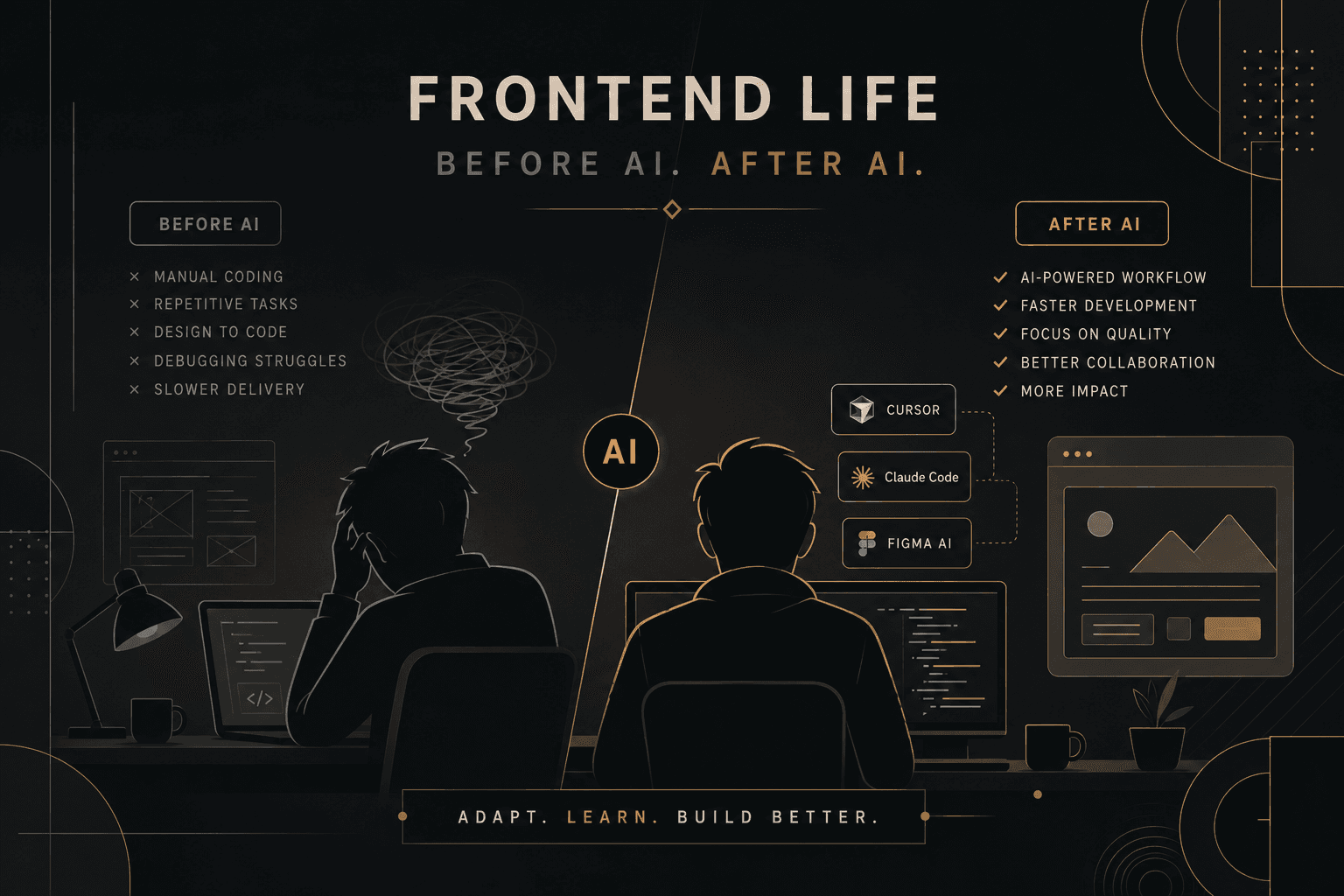
The frontend life before AI was slower, more manual, and sometimes repetitive.
The frontend life after AI is faster, more automated, and sometimes more chaotic.
Before, the challenge was building everything by hand.
Now, the challenge is knowing what to trust, what to reject, and what to improve.
That is not a smaller job. It is a different job.
For frontend developers, the future is not about competing with AI at typing code. That battle is already pointless. AI will type faster. It will generate faster. It will suggest faster.
The real value is in direction, judgment, quality, and ownership.
Know your tools. Learn the fundamentals. Get better at reviewing code. Understand design systems. Improve your product thinking. Use AI to speed up your work, but do not let it replace your skill.
AI will change frontend development, but it does not remove the need for frontend developers.
It raises the bar.
And the developers who adapt early will not just survive this shift.
They will probably enjoy it.